KNOW
Evidence before inference
- Europe PMC · PubMed · OpenAlex retrieval
- Crossref citation graph
- SearXNG web search (self-hosted, configurable)
- Robots-aware full-text retrieval / crawling
- DOI & title verification
- Claim-level evidence grading
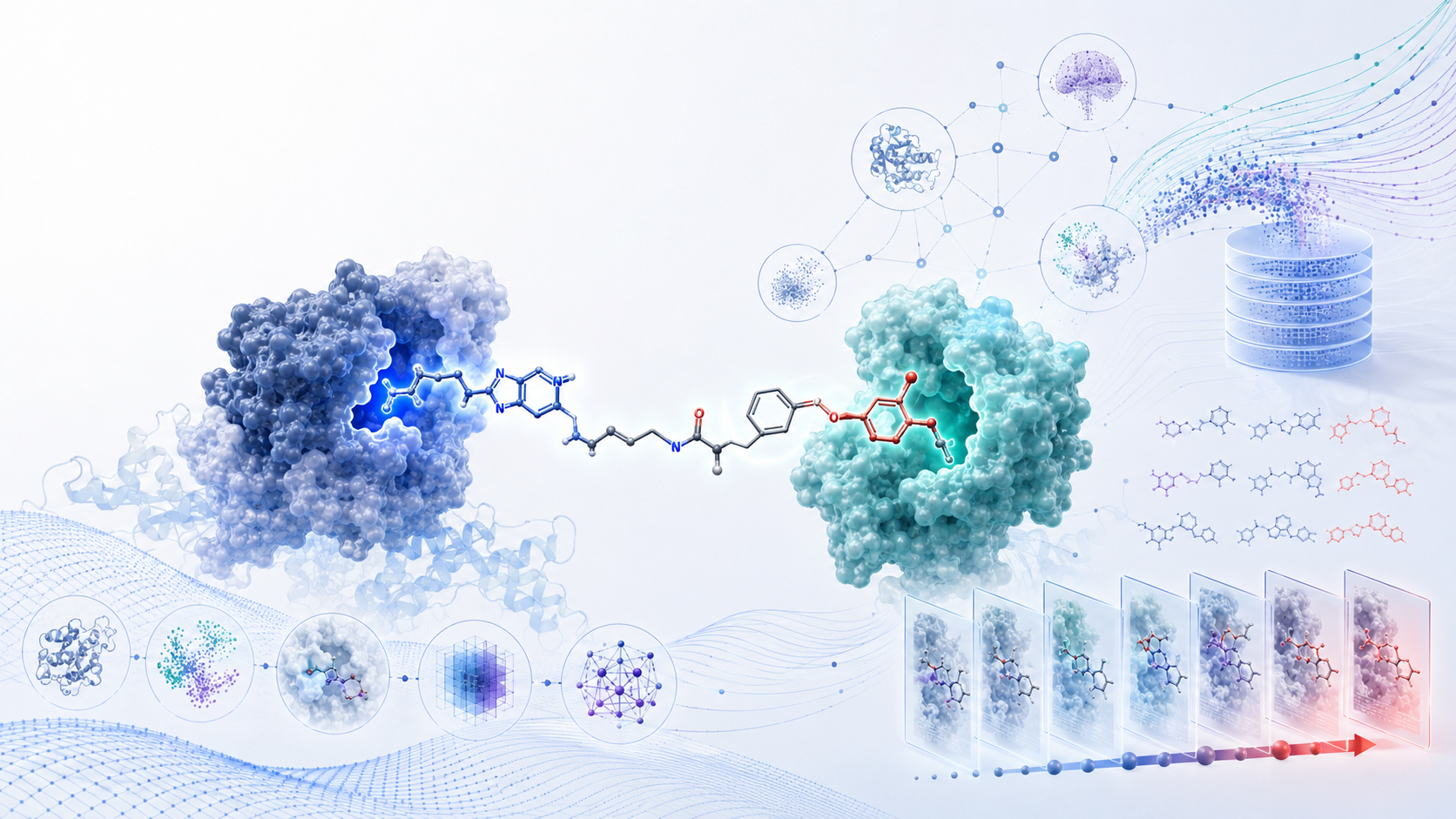
PROTACXtend couples scientific literature and biochemical databases with component-aware molecular design and controlled chemical-space search. It then models ternary-complex physics and mechanistic degradation with DC50/Dmax prediction under cell-context reasoning — every candidate decision carries explicit provenance, uncertainty and applicability-domain checks.
A research system, not a demo — every stage runs with its own tools, models and an explicit evidence type, and walkthrough values are illustrative unless marked otherwise.
ABOUT · 01
No single molecular descriptor predicts degrader success. PROTACXtend makes every contributing layer independently inspectable.
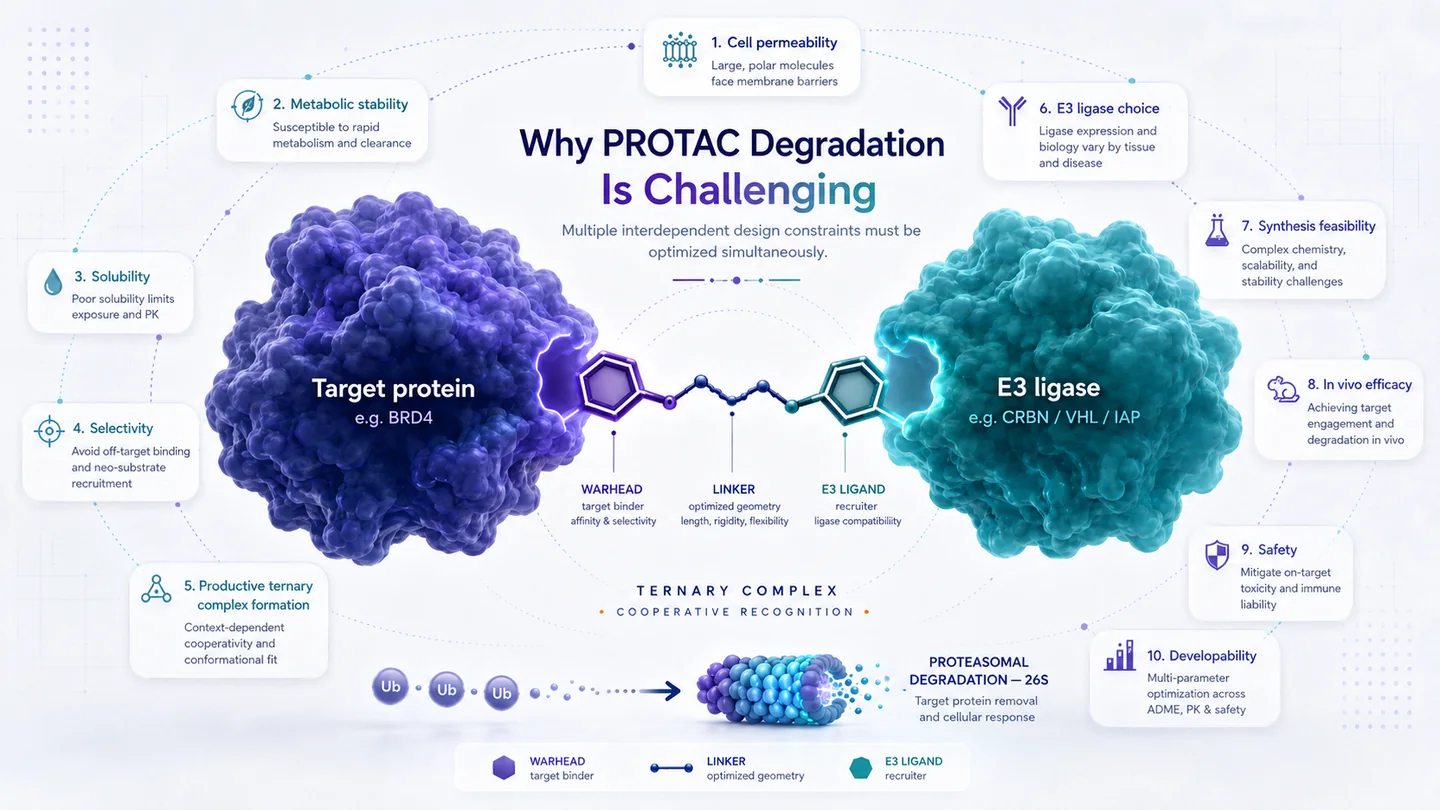
A PROTAC cannot be optimized from molecular structure alone. Potency depends jointly on warhead engagement, E3 recruitment, linker geometry, ternary-complex topology, cooperativity, accessible ubiquitination geometry, intracellular concentration, cellular ubiquitin–proteasome context and developability. These factors interact nonlinearly and can generate counterintuitive behaviours including the hook effect.
PROTACXtend decomposes this coupled problem into independently inspectable evidence and modeling layers. Research agents retrieve and verify evidence; chemistry modules construct and validate candidates; structure-aware modules evaluate ternary and ubiquitination feasibility; degradation models estimate DC50 and Dmax; transcriptomic context models condition predictions on cellular state; and ranking modules combine potency, uncertainty, novelty, ADMET and synthetic feasibility without hiding missing evidence.
SCIENTIFIC LOOP · 02
The platform is organised around the research workflow a degradation biologist actually follows — not around "agents". Each stage names its sources, models and statuses.
Evidence before inference
Evidence into explicit design decisions
Constrained chemical & structural search
Prioritize by converging independent evidence
MECHANISTIC LAYERS · 03
PROTACXtend models distinct mechanistic determinants instead of collapsing degrader efficacy into a single score.
Mass-action three-body equilibrium over binary and ternary species: peak and maximum ternary occupancy, hook onset and severity, dose window — with seeded Monte-Carlo uncertainty propagation.
Limitation: equilibrium modeling, not degradation kinetics; input affinities come from experiment or upstream layers.
Static-geometry scorer of E2 catalytic-site accessibility to POI lysines: Shrake–Rupley SASA, distance, approach angle, steric occlusion and the productive fraction of an ensemble.
Limitation: static-geometry baseline; real-PDB benchmark is pending — synthetic-fixture validated today.
A feasibility score, not a trained experimental-α predictor. Surrogate mode until a curated experimental cooperativity dataset exists; grouped-split benchmark harness (constant / ridge / RF / XGB / GP) is ready.
Limitation: experimental cooperativity (α) prediction is data-gated.
pDC50 / Dmax regression trained on a curated set of 64/32 published labels with grouped splits; a separate transcriptomic cell-context model conditions pDC50 on DepMap 24Q4 expression.
Limitation: small curated label set; transcriptomic only — proteotype coverage is not claimed; unseen-cell-line transfer is not claimed.
MODEL PANEL · 04
Predictors are kept independent with their provenance shown — models are never averaged silently, and any unified integration is labelled "under evaluation".
| Predictor | Endpoint | Type | Training-data provenance | Validation regime | Status |
|---|---|---|---|---|---|
| Module 4 — degradation ML | pDC50 · Dmax | LEARNED PREDICTION | 64/32 curated published labels | grouped splits: random · scaffold · unseen-target · E3 · PROTAC; 9/9 audit tests | TRAINED |
| Module 5 — cell context | cell-context pDC50 | LEARNED PREDICTION | PROTAC-Degradation-DB (1913 rows) + DepMap 24Q4 transcriptomics (1512 rows) | grouped A–G; leg D > leg B on unseen-PROTAC pDC50 (R² 0.605 vs 0.513); 16 tests | TRAINED |
| TACK — DC50 | DC50 | LEARNED PREDICTION | TACK dataset | calibration parquet + meta committed | TRAINED |
| TACK — Dmax / binary | Dmax · active/inactive | LEARNED PREDICTION | TACK dataset | calibration parquet + meta committed | TRAINED |
| SynGlue — DC50 / Dmax | DC50 · Dmax | LEARNED PREDICTION | GROVER / multitask-transformer encodings | RF regressors + transformer committed | TRAINED |
| Unified degradation engine | ensemble verdict | HEURISTIC | — (integration layer) | model-disagreement & uncertainty-aware integration in evaluation | UNDER EVALUATION |
Each predictor ships with its artifact path (e.g. modules/degradation_ml/models/pdc50_model.joblib, data/tack/tack_dc50_model.joblib, data/synglue/models/rf_dc50.joblib). Verdicts cite which model produced them and with what applicability-domain state.
ARCHITECTURE · 05
23-node core scientific workflow + 8 controlled-search and feedback extensions = 31 documented agent nodes. The orchestration graph executes nodes in sequence and stops only at terminal evidence or error gates.
Each executed scientific step records its input, output, evidence source, tool/model version, confidence, applicability-domain status, warning state and limitation. No agent silently mutates another node's conclusions.
$ protacxtend contract --target BRD4 --e3 CRBN
→ KNOW-REASON-DESIGN-DISCOVER dossier: sources cited, gates passed
$ protacxtend structure --smiles "<PROTAC>" --pose model_0
→ lysine ubiquitination feasibility + cooperativity feasibility (surrogate)
$ protacxtend dose --smiles "<PROTAC>"
→ ternary dose-response · hook onset & severity · MC uncertainty
$ protacxtend context --smiles "<PROTAC>" --cell-line HeLa
→ cell-context-aware degradation verdict (Module 5), with model tag
WORKFLOWS · 06
One CLI, real subcommands, structured JSON/CSV output — each workflow names the models and evidence types it touches.
designcore pipelineDeterministic end-to-end candidate generation: target resolution → assembly → validation → ADMET/novelty → ranking → report.
protacxtend design \
  --target BRD4 --e3 CRBN \
  --num-candidates 16
structurestructural surrogatePose-backed lysine ubiquitination geometry scoring and cooperativity feasibility for one candidate.
protacxtend structure \
  --smiles "<PROTAC>" \
  --target-pdb 3U5L
doseequilibriumTernary dose-response simulation: hook onset, severity, occupancy window — equilibrium, with MC uncertainty.
protacxtend dose \
  --smiles "<PROTAC>"
contextcell contextCell-context-aware degradation prediction (Module 5, transcriptomic) — model and applicability domain reported.
protacxtend context \
  --smiles "<PROTAC>" \
  --cell-line HeLa
validatechemistry gateRDKit validation and scoring of a single PROTAC SMILES: sanitization, exit vectors, ADMET profile.
protacxtend validate \
  --smiles "O=C1NC(=O)..."
ask · learn · apiresearch surfaceSearch databases & literature (ask), recommend next experiments (learn, partial), or serve the FastAPI backend (api).
protacxtend ask "HMGB2 E3 ligases"
protacxtend api --port 8001
BROWSER WALKTHROUGH · 07
Explore the shape of a PROTACXtend run — including retrosynthesis and mechanistic module stages. This browser-only walkthrough uses precomputed illustrative values; it does not execute the scientific backend.
ILLUSTRATIVE trace. Stages shown: KNOW retrieval · REASON · linker design · retrosynthesis · assembly · ADMET · ternary · ubiquitination · cooperativity · hook effect · degradation (M4) · cell context (M5) · Pareto ranking.
| Rank | PROTAC candidate | M4 pDC50 | Ternary feas. | Retro. feas. | ADMET | Status |
|---|---|---|---|---|---|---|
| Run the walkthrough to see an illustrative output shape. | ||||||
SCIENTIFIC VALIDATION · 08
Source of truth: config/scientific_status.yaml. Statuses are per capability, not page-level. Green is not used alone — every claim carries a caveat column.
| Capability | Implemented | Evidence type | Data source | Validation | Current limitation | Public claim |
|---|---|---|---|---|---|---|
| Deep-research retrieval | ✓ | RETRIEVED | Europe PMC · PubMed · OpenAlex · Crossref · SearXNG | live-API smoke + tests | SearXNG needs self-hosted instance | YES |
| Hook-effect modeler | ✓ | CALCULATED | validated mass-action equations | 13/13 tests, QA 2026-09-02 | equilibrium only — no kinetics | YES |
| Lysine ubiquitination feasibility | ✓ | STRUCTURAL SURROGATE | pose geometry (SASA, angles) | synthetic fixtures | real-PDB benchmark pending | PARTIAL |
| Cooperativity | ✓ (surrogate) | STRUCTURAL SURROGATE | feasibility scoring | harness ready (ridge/RF/XGB/GP) | experimental α dataset absent — prediction data-gated | DATA-GATED |
| Degradation ML (M4) | ✓ | LEARNED PREDICTION | 64/32 curated published labels | grouped splits; audit 9/9 | small label set | YES |
| Cell-context degradation (M5) | ✓ | LEARNED PREDICTION | PROTAC-Degradation-DB + DepMap 24Q4 RNA | grouped A–G; 16 tests | transcriptomic only; unseen-line transfer & proteotype not claimed | YES |
| Unified degradation engine | ± | HEURISTIC | integration layer | disagreement/uncertainty checks | not production — under evaluation | NO |
| Novel E3 opportunity | ✗ | NOT AVAILABLE | — | — | Module 6 planned | NO |
| Active learning | ± | HEURISTIC | CLI surface only | — | BO + feedback module not built (Module 7) | NO |
DOCUMENTATION · 09
Technical how-to for what ships in the repository: databases, live APIs, tools, models and spreadsheet assets — with source paths for each.
Python 3.10+ with conda is recommended for RDKit / PyTorch isolation. Two supported install paths — both run from the repository source; PyPI publishing is on the roadmap.
git clone https://github.com/the-ahuja-lab/PROTACXtend.git
cd PROTACXtend
conda create -n protacxtend python=3.10 -y
conda activate protacxtend
pip install -r requirements.txt
pip install -e .docker build -t protacxtend https://github.com/the-ahuja-lab/PROTACXtend.git
docker run -p 8501:8501 -p 8001:8001 protacxtendprotacxtend status # runtime status
protacxtend capabilities # terminal + scientific capabilities
protacxtend scenarios # example runs & cost estimatesCommitted model artifacts and curated data are checked by the CI security job; nothing model-sized needs re-downloading to run offline tests.
Machine-readable status source: config/scientific_status.yaml. Full module docs live beside each module under docs/{README,ARCHITECTURE,USAGE,VALIDATION,LIMITATIONS,REFERENCES}.md.
UniProttarget resolution · protein metadata (live API)ChEMBL · PubChembinders, warheads, bioactivity evidence (live API)BindingDBaffinity evidence (live API / TSV mode)Europe PMC · PubMed · OpenAlex · Crossrefresearch retrieval + citation graph (research/sources.py)# read an xlsx asset
from openpyxl import load_workbook
wb = load_workbook("Agent_Toolkit.xlsx")Built sequentially, each module gated by tests, a demo output, documented limitations and agent integration. Tracker: protacxtend/modules/PROTACXTEND_MODULE_BUILD.md; status YAML: config/scientific_status.yaml.
M1Hook Effect Modeler — three-body equilibrium, hook onset/severity · VALIDATED BASELINEM2Lysine Ubiquitination Feasibility — static-geometry scorer · PARTIAL (real-PDB benchmark pending)M3Cooperativity — feasibility/surrogate mode · DATA-GATEDM4Degradation ML — pDC50/Dmax, curated 64/32 labels · TRAINEDM5Cell-context selector — transcriptomic (DepMap 24Q4) · TRAINED (proteotype not claimed)M6Novel E3 opportunity engine · PLANNEDM7Active learning / experiment selection · PLANNED (CLI surface exists)protacxtend/modules/degradation_ml/models/pdc50_model.joblib
protacxtend/modules/cell_context_selector/models/cell_context_model.joblib
data/tack/tack_{dc50,dmax,bin}_model.joblib (+ calibration parquet)
data/synglue/models/rf_{dc50,dmax}.joblib
data/synglue/models/multitask_transformer.pt · data/synglue/models/grover_fixed.pt
outputs/benchmark/chemprop_multitarget/model_0/best.ptModels are invoked through tagged tools; verdicts report which model(s) produced them. The unified engine is under evaluation and is never presented as production.
Every workflow writes structured output and cites its evidence/model layer.
protacxtend design --target "BRD4" --e3 "CRBN" \
  --num-candidates 16 --output ./results/brd4_run.json
Core 23-node path: resolution → binders/warheads/E3 → exit vectors → linkers → construction → stereoisomers → validation → ADMET · novelty · applicability domain → degradation ML → ranking; controlled-search extensions follow when their gates open.
protacxtend structure --smiles "<PROTAC>" --target-pdb 3U5L --e3-pdb 4CIW
protacxtend dose      --smiles "<PROTAC>"              # hook equilibrium
protacxtend context   --smiles "<PROTAC>" --cell-line "HeLa"
protacxtend validate --smiles "<PROTAC>"protacxtend ask "HMGB2 degradation E3 options" # search tools/databases/literature
protacxtend contract --target BRD4 --e3 CRBN # KNOW-REASON-DESIGN-DISCOVER dossier
protacxtend learn # recommend next experiments (partial)protacxtend api # FastAPI backend (default :8001)
protacxtend ui # Streamlit frontend (default :8501)from protacxtend.agents.graph import run_syn_glue_workflow
state = run_syn_glue_workflow(
request="Design 10 CRBN PROTAC candidates for HMGB2 with low hERG risk",
config={"persistent": True, "max_iterations": 3})
dossier = state.get("report_markdown", "")from protacxtend.tools.protac_toolbox import PROTACMasterToolbox
tb = PROTACMasterToolbox()
vectors = tb.detect_exit_vectors(warhead_smiles="...")
protac_sm = tb.assemble_protac(warhead_smiles="...", linker_smiles="...", e3_smiles="...")POST /designstructured end-to-end design runPOST /modeagentic mode routingGET /healthbackend livenesscurl -X POST http://localhost:8001/design \
-H "Content-Type: application/json" \
-d '{"request":"Design 20 CRBN PROTAC candidates for BRD4","num_candidates":20}'Repository: github.com/the-ahuja-lab/PROTACXtend — canonical Ahuja Lab home (full code + Pages)
Live site: the-ahuja-lab.github.io/PROTACXtend
Development mirror: github.com/SaveenaSolanki/PROTACXtend
Lead developer: @SaveenaSolanki · Lab: @the-ahuja-lab (IIIT Delhi)
Every push runs CI: compile + asset-free smoke, fast offline units, the full offline suite (including the agentic E2E benchmark), plus gitleaks full-history scan, ruff and committed-artifact checks.